Channel all of your rage into your workout and experience benefits
When I was in high school, I was non particularly athletic. I saturday the demote on the junior varsity baseball team and quit freshman basketball afterward ii weeks.
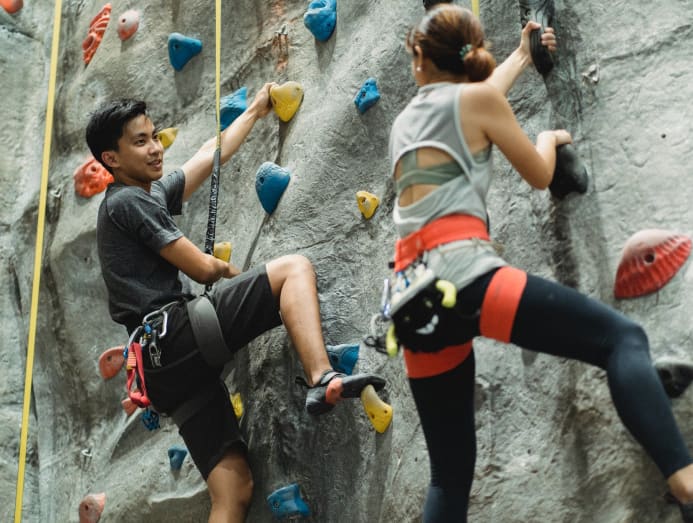
And even so, I still wanted to discover a sport that was correct for me, so I got into stone climbing. I wasn't adept at that either, merely I loved the feeling information technology gave me. Climbing seemed to eye me.
On Friday I'd exist a distracted mess of hormones and teen malaise. On Sun, I would dangle 24m off the ground, scared out of my gourd, and past Monday, schoolwork just seemed easier. How did something and then terrifying make the earth feel less chaotic and stressful?
There is no uncertainty that practise is good for your heart and your mental health. Or that calming activities like yoga or tai chi can assist you experience refreshed and recharged.
But what about less calm activities? Is parkour jumping from a rooftop or slamming a lawn tennis ball beyond the courtroom good for the heed?
Traditional exercise psychologists might say no, because anything that spikes your stress hormones, be information technology through fear or assailment, is not skillful for mental health.
Small studies accept bolstered this belief; one suggested that racquetball's "competitive nature" is less relaxing than weight or circuit grooming, while some other found that adding stress to a biking conditioning hampers immune office.
And certainly this Olympic year was a lesson in the dangers of over-stressing elite athletes on and off the field.
Just this doesn't mean that emotions like stress or aggression have no place in exercise. Almost whatever passionate athlete will tell you their sport is as much a mental wellness aide as a physical one.
You've got to clear your head, get correct in the brain, blow off some steam. For some of us, those seemingly negative emotions during practise are the whole reason to piece of work out.
GETTING SCARED IS A Good LIFE SKILL
It might seem strange that the best way for me to deal with stress is to basically flood my brain with information technology, but without things similar climbing or river kayaking, I don't think I could accept gotten through these final 17 months.
Adrenaline sports have also long been popular with veterans dealing with mail service-traumatic stress disorder. One creative group of High german scientists fifty-fifty experimented with rock climbing as a class of therapy for depression.
The results were moderately good, but just the fact the scientists chose rock climbing suggests some emotional do good for fright. Strange every bit information technology may sound, fearfulness can exist deeply therapeutic.
Omer Mei Dan, a Boulder-based orthopaedic surgeon, researcher and former professional BASE jumper, and Erik Monasterio, a forensic psychologist at the Academy of Otago in New Zealand and lifelong mountaineer, have tried for years to understand what part the personalities of aristocracy extreme athletes play in choosing to risk their lives and then process those experiences.
They have repeatedly found that people who climb upwards or jump off rocks for a living score high in their need to seek out new things and "pathologically" low in their concerns about getting hurt.
"They demand to exist pushing themselves, working a really hard rock route, windsurfing, trying to do some new trick," Dr Monasterio said. He and Dr Mei Dan have fifty-fifty suggested that these personality traits confer some grade of resistance to psychological trauma.
For some, they said, it might exist that experiencing fearfulness and stress while flying off a halfpipe with your skateboard or jumping from a plane trains your brain to bargain with these emotions in other parts of your life.
BLOW OFF SOME STEAM
Psychologists once saw the human being psyche as a pipe or hose that occasionally gets backed up with emotion, and that people needed to release pressure to stay healthy.
"Catharsis theory," every bit it was known, said that if you're angry, you should get outside and hammer on some nails.
This notion has not held upwardly well, partly because researchers accept found when angry people blow off steam hammering nails, they frequently come up dorsum just every bit angry (or angrier) than before.
And withal, catharsis is existent; it'southward a good weep at a pitiful film or fifty-fifty a nighttime eating the spiciest tacos you can handle. Crying especially can help u.s.a. process emotions and release anxiety, said Lauren Bylsma, an emotions expert at the University of Pittsburgh.
And this is why athletes might feel good afterwards a competitive game or a scary ski run.
"When you have a loftier level of emotion and then you accept that release, it can take that cathartic-like experience and you kind of feel that release of tension," she said. "I could run across that being applied non just to crying or sadness, but also fearfulness."
SOMETIMES A Fiddling Aggression CAN Aid
So, what is information technology about negative emotions that help us occasionally clear our minds?
"Y'all can't neatly divide emotions into positive or negative," said Abigail Marsh, an acquaintance psychology professor at Georgetown University and the author of The Fear Gene: How One Emotion Connects Altruists, Psychopaths, and Anybody In Between.
"Anger, for some people, is described as feeling negative. But other people describe it every bit feeling positive."
Nowhere is this more obvious than in competitive youth sports, which Dr Marsh called a "formalised, culturally adequate form of aggression."
Parents might put unruly kids into football game, karate or wrestling in the hopes that it somehow levels them out. But does it?
Many studies over the years take plant that young people, often men, who participate in aggressive sports tend to corroborate of violence, and even resort to it more often than people in other sports or non-athletes.
But Mitch Abrams, a sports psychologist based in Tinton Falls, New Jersey, and an adept in anger management in athletics, said this paints with too broad a stroke.
For some people, he said, engaging ane's aggressive feelings in a sport may help them to manage their feelings. He even occasionally prescribes aggressive activities like martial arts as a way to confront trauma.
Merely he is as well careful not to prescribe it to people with rage issues, saying that there is a level of maturity needed to harness aggression.
"There's a take a chance," he said. "If you lot feel better later on striking something, yous might be more likely to strike something again in the future."
REST AND Digest
The most important thread that ties intense emotions to exercise might be less psychology and more biological science. Both fear and aggression trigger the sympathetic nervous system – the so-called fight or flight response.
In doing so, they can then trigger the parasympathetic nervous system which is loosely called "residual and digest." Sympathetic responses are defined by high cortisol, high claret pressure and center rates, sweat and dilated pupils.
Conversely, the parasympathetic reactions trigger low blood pressure level and heart rates, increased metabolism and, importantly, a flushing of cortisol from the organisation. It'southward the deep, nearly spiritual calm that comes after the storm.
Dr Monasterio said information technology took him a few years climbing in his teens to recognise this. "At the fourth dimension I didn't realise what was hooking me in – that information technology'south this calmness that followed farthermost practice."
Parasympathetic responses are tough to just plow on, though some say breathing exercises and meditation can trigger them. But the simplest way to become that calm is to engage a fight or flight response get-go.
Alejandro Lucas Mulas, a researcher at the European University of Madrid, who has studied the parasympathetic system in sports, has constitute that feeling later on an intense workout tin can last for hours, making you lot calmer, happier and less likely to snap or become stressed.
I've recently discovered the pleasance of working out on a boxing dummy (with an especially punchable face up), which gives me a similar release to climbing, but can exist done closer to dwelling.
Am I but chasing a parasympathetic response? Am I a thrill seeker or a post-thrill seeker? In the end, it's not clear that scientific discipline has one articulate respond yet.
Certainly, when I'm frightened on a rock somewhere, I'thousand non having much fun in the moment, only rather just trying to desperately scrabble to safety. Information technology'southward only afterwards, tired and a little beaten up, looking over the mountains at the setting lord's day, that I really enjoy rock climbing.
And I can walk down the trail, os-weary and grin, relaxed and ready for the calendar week alee.
By Erik Vance © 2022 The New York Times
This article originally appeared in The New York Times.
https://www.nytimes.com/2021/08/11/well/move/workout-stress-fright.html
Source: https://cnalifestyle.channelnewsasia.com/wellness/channel-rage-workout-benefits-275461
0 Response to "Channel all of your rage into your workout and experience benefits"
Post a Comment